The case of Almaty International Airport
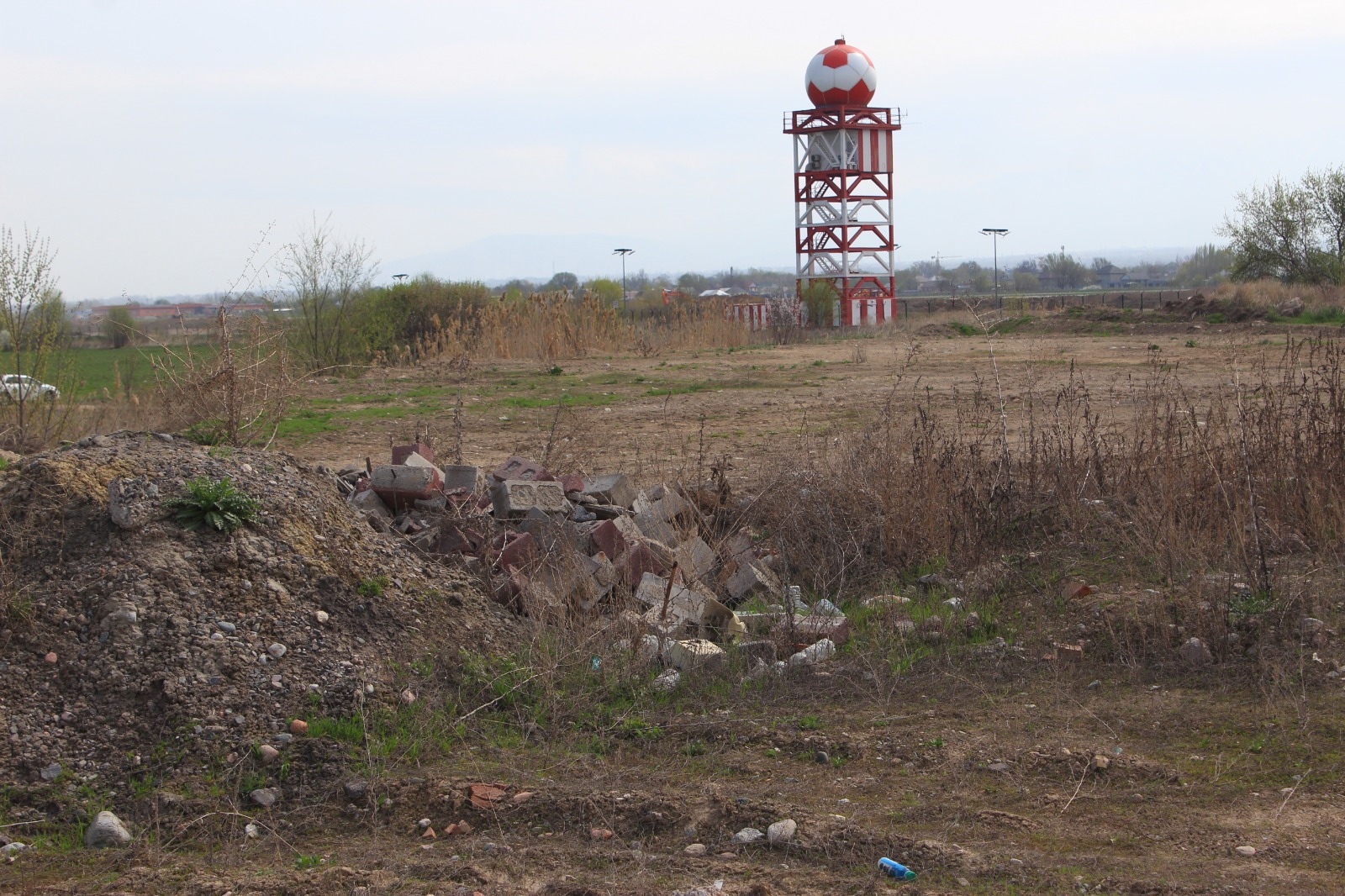
Illegal dumping sites and overgrown vegetation on the northern side of the airport where the sanitary protection zone should have been established (photos: Green Salvation, 5 April 2026).
Since 2021, the joint stock company Almaty International Airport has been implementing the Almaty International Airport Expansion Project, including the construction of a new international airport terminal (1). In 2025, the company launched an additional initiative – the Horizon Project – to upgrade airside infrastructure, primarily on airport-owned land (2). Financing of USD 229 million for both projects is being provided by the European Bank for Reconstruction and Development (EBRD) , with an additional USD 300 million from the International Finance Corporation (IFC)(3). According to the Horizon Project’s environmental and social impact assessment, published in September 2025, both projects form term development framework (4).
In 2025, following sustained monitoring of alleged violations of national law and international financing standards, the Almaty-based Ecological Society Green Salvation submitted a formal complaint with the EBRD’s Independent Project Accountability Mechanism (IPAM) (5). The complaint concerns the demolition of the airport’s 1947 VIP terminal building – a protected cultural monument – in violation of Kazakhstan’s heritage protection laws and the EBRD’s Environmental and Social Policy (6).
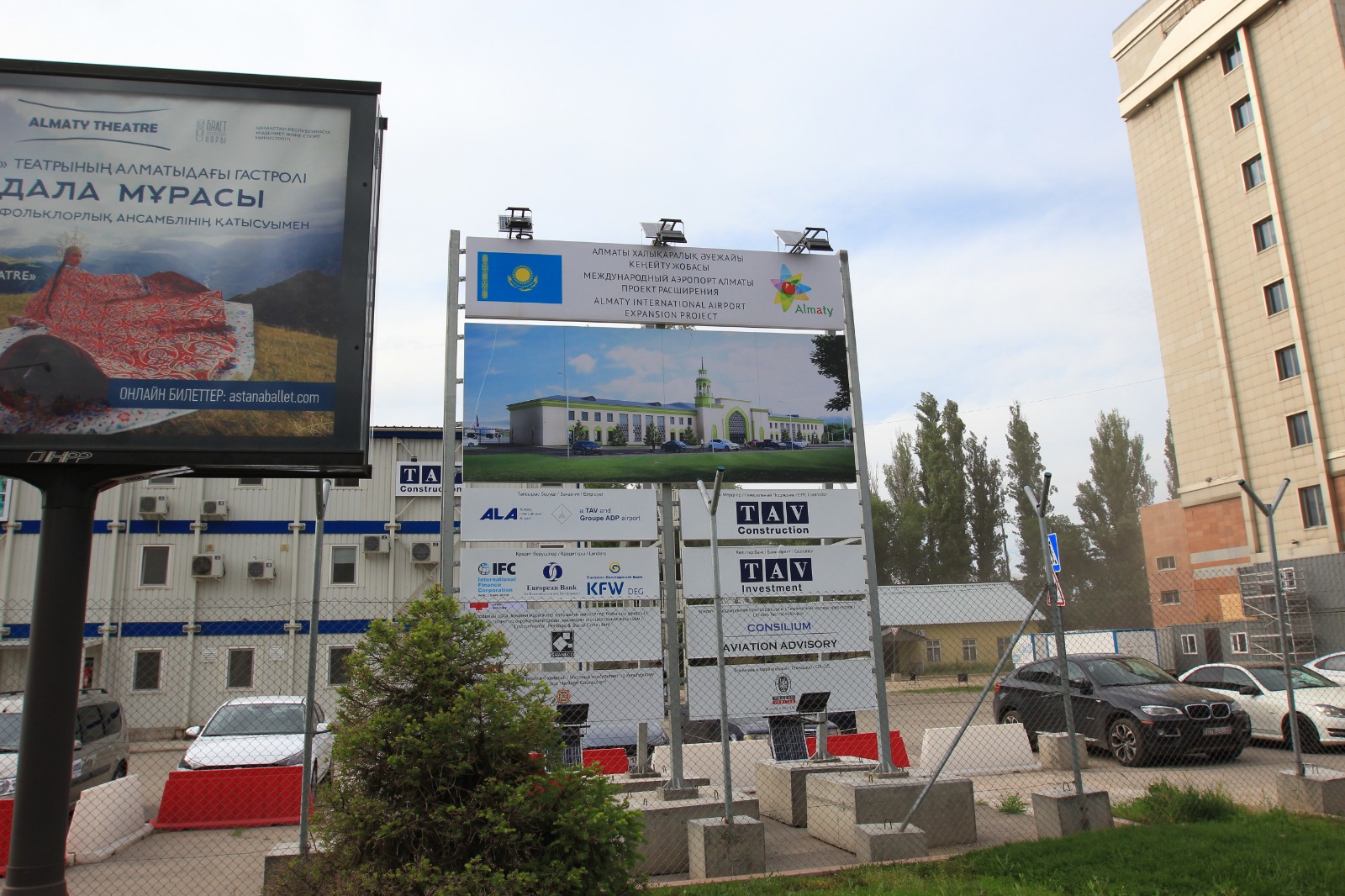
Project information board for the Almaty International Airport Expansion Project (photo: Green Salvation, 20 May 2022).
Failure to establish sanitary protection zones
During its monitoring of both projects, Green Salvation also identified issues with the establishment of sanitary protection zones around the airport. Under national health and environmental legislation, such projects require the establishment of a preliminary sanitary protection zone, followed by the development of a permanent zone within one year (7).
Almaty Airport is situated within city limits in close proximity to residential areas. In March 2026, the Transport Sanitary and Epidemiological Control Department (part of Kazakhstan’s Ministry of Health) informed Green Salvation that no application for a sanitary protection zone had been submitted for the Horizon Project (8).
Consequently, as of this date, no permanent zone has been approved for the Expansion Project, and no preliminary zone has been established for the Horizon Project.
Concerning the Expansion Project, the Department also confirmed that it issued a reasoned refusal on 21 May 2024 in response to the company’s initial application for a sanitary protection zone, noting that the company had failed to resubmit a revised application. Consequently, no sanitary–epidemiological conclusions – legally required to establish such a zone – have been issued for either project.
Indeed, the project documentation acknowledges this situation. The environmental and social impact assessment report, updated in 2025, notes that matters pertaining to the sanitary protection zone, including a methodology for calculating the distance of the zone from residential areas, were discussed during public hearings in October 2024.
However, the report also states that the company’s application to establish a sanitary protection zone was still awaiting approval, which directly contradicts the Department’s communication with Green Salvation that it had not received a revised submission following its refusal of the company’s initial application in May 2024.
Initially, documentation for the Expansion Project stipulated that development would only proceed if the Kazakhstani government formally committed – through key support and resettlement agreements – to establish the required sanitary and safety protection zones in accordance with land acquisition standards. According to the original EBRD project page, these commitments were a prerequisite for the project to move forward.
The project documentation for both projects was updated in 2025. The Horizon Project page now outlines revised commitments towards affected communities, including noise mitigation measures, possible resettlement solutions, and the creation of a multi-agency working group to advance the establishment of a sanitary protection zone.
In January 2026, the IFC informed monitors that it was aware of the delays and was engaging with the authorities to advance regulatory approval, while committing to monitoring compliance with both IFC standards and Kazakhstani law.
Despite the revised documentation and rising passenger numbers, the airport continues to operate and expand without an established sanitary protection zone, in breach of national legislation.
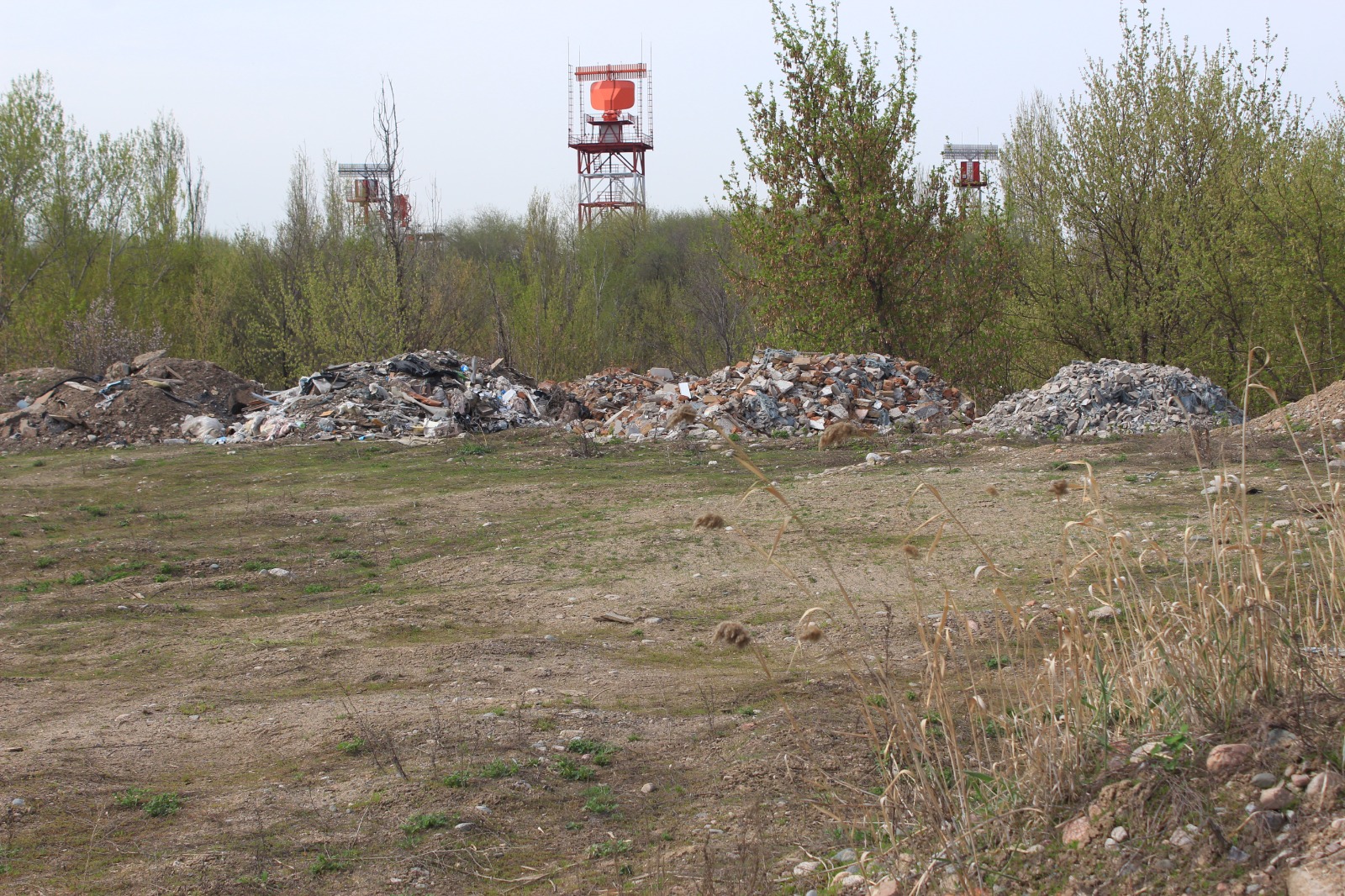
Illegal dumping sites and overgrown vegetation on the northern side of the airport where the sanitary protection zone should have been established (photos: Green Salvation, 5 April 2026).
Barriers to participation and access to information
The stakeholder engagement plans for both projects outline the format for public consultations and measures to remove barriers to participation and access to information. However, a request by Green Salvation for further details on the company’s efforts to establish the requisite sanitary protection zones was refused on the grounds that it did not constitute a request for environmental information. However, this position contradicts Articles 17 and 18 of Kazakhstan’s Environmental Code (9) as well as EBRD and IFC requirements on transparency and stakeholder engagement.
Furthermore, under Article 58 of Kazakhstan’s Law on Architectural, Urban Planning, and Construction Activities (10), as well as the Environmental Code, a sanitary protection zone must be established for facilities that impact the environment and human health. The sanitary protection zone is designed to legally protect both the environment and the well-being of local communities by separating industrial activities from residential areas, while reducing harmful impacts on public health, environmental safety, and living conditions.
Intimidation tactics
Following the company’s refusal to disclose the information requested, Green Salvation filed a lawsuit with the Specialised Interdistrict Economic Court of Almaty on 12 December 2025. On 23 February 2026, the court ruled in favour of the company; in response, Green Salvation lodged an appeal with Almaty City Court on 1 April 2026.
In a concerning development, during both the court hearing and the company’s written defence, its legal representative exerted retaliatory pressure against Green Salvation. The representative alleged that the organisation may have been acting with the deliberate intent of creating a negative perception of the defendant’s activities, referring to its previous submission of so-called ‘misleading information’ through IPAM.
Such statements are unacceptable under the Aarhus Convention (11), which stipulates that individuals and groups exercising their environmental rights must not be subjected to harassment or intimidation. Indeed, the EBRD’s statement on Retaliation Against Civil Society and Project Stakeholders affirms the right of any individual or group to raise concerns or complaints in relation to EBRD-financed projects without fear or threats of reprisal (12) Green Salvation has since reported the incident to IPAM and the responsible officers at the EBRD and IFC. In a response issued in March 2026, the IFC reaffirmed its zero-tolerance policy towards retaliation and intimidation against civil society and project stakeholders. In May 2026, the EBRD’s Civil Society Engagement Unit acknowledged the issues raised, reiterated the Bank’s position supporting the free expression of opposition and concerns by project stakeholders, and offered a follow-up meeting with the EBRD’s environmental and social team. Monitors are currently awaiting further responses from IPAM on the matter.
Conclusions
While this case relates to a specific local context, the consistent failure to address procedural, legal and safeguard requirements across both projects raises broader questions about oversight and accountability in infrastructure projects financed by development banks.
In particular, the case highlights challenges in enforcing national law, implementing environmental and social safeguards, and ensuring that such projects adhere to the banks’ stated standards and objectives.
Given the issues outlined above, both the EBRD and the IFC should address the following questions:
1. Why did neither institution ensure effective oversight?
2. What actions will they take to resolve the alleged issues of non-compliance?
3. What guarantees can they provide that similar violations will not occur in other projects in Kazakhstan?
As Green Salvation awaits the results of IPAM’s investigation into its formal complaint, it reiterates its call for both the EBRD and IFC to take immediate measures to ensure that both projects strictly comply with national law, the EBRD’s Environmental and Social Policy, and the IFC’s Performance Standards on Environmental and Social Sustainability.
Both banks and their client in the Almaty International Airport development projects should guarantee unconditional transparency and free access to environmental information concerning the formal establishment of the sanitary protection zone.
The lenders should also ensure a thorough investigation into reported cases of reprisal and require their clients to fully implement commitments related to the prevention of retaliation and the protection of project stakeholders, while preventing any further cases of retaliation.
https://bankwatch.org/wp-content/uploads/2026/05/2026_05_Broken-safeguards-and-oversight-failures_The-case-of-Almaty-International-Airport-2.pdf.
________________________
For more information:
Polina Veretelnikova
Central Asia Coordinator CEE Bankwatch Network
polina.veretelnikova@bankwatch.org
- European Bank for Reconstruction and Development, Almaty International Airport expansion, accessed 25 April 2026, https://www.ebrd.com/home/work-with-us/projects/psd/51186.html.
- European Bank for Reconstruction and Development, Almaty International Airport expansion extension, last updated 19 August 2025.
- International Finance Corporation, Almaty Airport II, last updated 10 April 2026.
- Mott MacDonald, Almaty International Airport | Environmental and Social Impact Assessment Report, 18 September 2025.
- Independent Project Accountability Mechanism, Almaty International Airport expansion, accessed 25 April 2026.
- Polina Veretelnikova, Replicability gone wrong: Demolition of cultural heritage and environmental risks at EBRD project in Kazakhstan, CEE Bankwatch Network, 8 December 2025.
- Minister of Health of the Republic of Kazakhstan, Приказ и.о. Министра здравоохранения Республики Казахстан от 11 января 2022 года №ҚР ДСМ-2 | Об утверждении Санитарных правил «Санитарно-эпидемиологические требования к санитарно-защитным зонам объектов, являющихся объектами воздействия на среду обитания и здоровье человека», paragraph 9, amended 19 April 2026.
- The Department issued the letter (ref: ЗТ-2026-00908682) in response to a letter from Green Salvation dated 1 March 2026.
- Parliament of the Republic of Kazakhstan, КОДЕКС РЕСПУБЛИКИ КАЗАХСТАН | ЭКОЛОГИЧЕСКИЙ КОДЕКС РЕСПУБЛИКИ КАЗАХСТАН, amended 1 January 2026.
- Parliament of the Republic of Kazakhstan, Закон Республики Казахстан от 16 июля 2001 года № 242 | Об архитектурной, градостроительной и строительной деятельности в Республике Казахстан, amended 31 August 2025.
- United Nations Economic Commission for Europe, Convention on Access to Information, Public Participation in Decision Making and Access to Justice in Environmental Matters, 25 June 1998.
- European Bank for Reconstruction and Development, Retaliation Against Civil Society and Project Stakeholders, January 2019.