Appeal by civil society of the Republic of Kazakhstan to the participants of the seventeenth meeting of the Conference of the Parties to the Convention on Biological Diversity.
Concerned by the ongoing destruction and loss of biodiversity in the natural ecosystems of the Trans-Ili Alatau (part of the Northern Tian Shan physical-geographic province), civil society of Kazakhstan appeals to the Conference of the Parties to draw the global community’s attention to instances in which the Republic of Kazakhstan has failed to comply with the norms of the Convention and the provisions of the Kunming-Montreal Global Biodiversity Framework (hereinafter—Framework).
1. We believe that Kazakhstan is not complying with Article 8(d).
The Concept for the Use of Biodiversity in the Republic of Kazakhstan for 2026–2035 (hereinafter—Concept) was approved by Resolution of the Government of the Republic of Kazakhstan No. 1206 dated December 31, 2025. Concurrently, the Comprehensive Plan for the Development of Tourism in the Almaty Mountain Cluster for 2025–2029 (hereinafter—Comprehensive Plan) was approved by Resolution of the Government of the Republic of Kazakhstan No. 1158 dated December 27, 2025[1]. In accordance with the Comprehensive plan, there are plans to establish ski resorts within the Ile-Alatau National Park—a site included in the Tentative Lists for nomination to the UNESCO World Heritage List[2]—to foster mass tourism.
We believe that these actions by the Republic of Kazakhstan run counter to Target No. 1 (of the Framework), which states that reducing threats to biodiversity requires ensuring “that all areas are under participatory, integrated and biodiversity inclusive spatial planning and/or effective management processes”. [3] The construction of ski resorts does not constitute “biodiversity inclusive spatial planning” and will vastly increase the anthropogenic impact on the national park’s ecosystems.
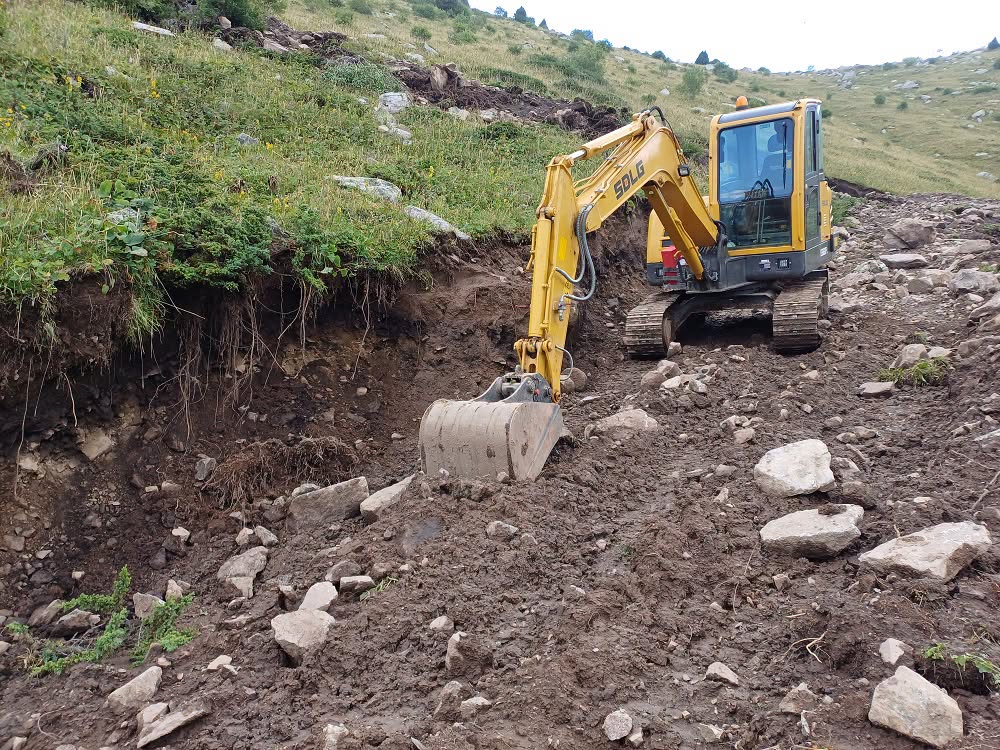
In July 2026, large-scale construction work began in the central part of the national park within the Kokzhailau tract—a habitat for diverse organisms and populations, including those listed in the Red Book of Kazakhstan and by the IUCN.[4] We consider these actions to be a violation of Article 8(d) of the Convention, which stipulates that “each Contracting Party shall, as far as possible and as appropriate: … (d) promote the protection of ecosystems, natural habitats and the maintenance of viable populations of species in natural surroundings.”
2. We consider that Kazakhstan is not in compliance with the requirements of subparagraphs (a) and (c) of Article 14, paragraph 1.
Subparagraph (a) of Article 14, paragraph 1 of the Convention states that each Contracting Party shall, as far as possible and appropriate:
“(a) Introduce appropriate procedures requiring environmental impact assessment of its proposed projects that are likely to have significant adverse effects on biological diversity with a view to avoiding or minimizing such effects and, where appropriate, allow for public participation in such procedures.”
However, the Tourism Industry Committee of the Ministry of Tourism and Sports of the Republic of Kazakhstan (hereinafter—Committee) takes the view that the “draft Comprehensive Plan for the Development of Tourism in the Almaty Mountain Cluster for 2025–2029 is not subject to a mandatory Strategic Environmental Assessment (SEA) under the provisions of Article 51, Paragraph 1 of the Environmental Code of the Republic of Kazakhstan, as SEA is conducted only for state programs, territorial development programs, and master plans for settlements.”[5] The Committee disregarded the fact that a significant portion of the national park lies within the administrative boundaries of the city of Almaty.
We draw your attention to the fact that the Aarhus Convention Compliance Committee considered the issue of constructing a ski resort in the Ile-Alatau National Park and found non-compliance with a number of the Convention’s articles.[6]
Article 14, paragraph 1(c) of the Convention on Biological Diversity states that each Contracting Party shall, as far as possible and as appropriate:
“(c) Promote, on the basis of reciprocity, notification, exchange of information and consultation on activities under their jurisdiction or control which are likely to significantly affect adversely the biological diversity of other States or areas beyond the limits of national jurisdiction, by encouraging the conclusion of bilateral, regional or multilateral arrangements, as appropriate.”
However, despite the vast scale of planned construction activities—including building on glaciers and deforestation—the issue of transboundary impacts on the territory of the Kyrgyz Republic is not addressed in official documents. Moreover, the “Conclusion on the Screening of Impacts of the Proposed Activity” states that “there are no transboundary impacts.” [7]
3. We believe that the aforementioned actions were made possible by the Republic of Kazakhstan’s systematic non-compliance with international environmental conventions, the weakening of environmental legislation, and increasing restrictions on access to information, decision-making processes, and justice.
4. We draw the attention of the Conference of the Parties to the fact that the official authorities of the Republic of Kazakhstan are making active efforts to create a favorable image on the international stage. At the opening of the Regional Environmental Summit in April 2026, Inger Andersen stated: “Central Asia’s biodiversity acts as resilience infrastructure: wetlands for flood buffering; forests, grass- and rangelands for soil stability and drought resilience; fragile glaziers that are the water towers of the region, and connected mountain habitats for climate‑driven species movement.”[8] She proposed that, as part of a program to accelerate innovations in nature-based solutions for Central Asia, Kazakhstan should submit its innovative proposals for the pilot project on sustainable infrastructure development through the integration of nature-based solutions by the end of June. Yet, in July 2026, the actual destruction of Ile-Alatau National Park began.
We believe that the actions of the state authorities of the Republic of Kazakhstan do not contribute to achieving the goals of the Convention on Biological Diversity and the Kunming-Montreal Global Biodiversity Framework regarding the conservation of biological diversity, the sustainable use of its components, and the fair and equitable sharing of benefits arising from the use of genetic resources.
Civil society of Kazakhstan requests that the Conference of the Parties, pursuant to Article 14, paragraph 2, investigate this matter and consider it in terms of “liability and redress, including restoration and compensation for damage to biological diversity.”
Civil society of Kazakhstan maintains that this issue has ceased to be a “purely domestic matter,” particularly given the presence within the Ile-Alatau National Park of migratory species listed in the IUCN Red Book.
During public campaigns opposing the construction of ski resorts, tens of thousands of signatures from individuals and legal entities worldwide were collected against the project—specifically, 33,500 signatures in 2018[9] and 10,500 in 2026[10].
Activists from the group, Let’s Preserve Kok-Zhailyau
EcoForum of Kazakhstan
Ecological Society Green Salvation
October 19, 2026
[1] https://www.gov.kz/memleket/entities/tourism/documents/details/793678?lang=ru.
[2] https://whc.unesco.org/en/tentativelists/1681/
[3] Kunming-Montreal Global Biodiversity Framework: https://www.cbd.int/doc/decisions/cop-15/cop-15-dec-04-en.pdf.
[4] https://www.iucnredlist.org/search/stats?query=Panthera%20uncia&searchType=species.
Panthera uncia: https://www.iucnredlist.org/species/22732/50664030/.
Malus sieversii: https://www.iucnredlist.org/species/32363/9693009/.
[5] Response from Tourism Industry Committee of the Ministry of Tourism and Sports of the Republic of Kazakhstan dated June 9, 2026 (Ref. No. ZT-2026-02172591) to the inquiry from the Green Salvation Ecological Society dated May 21, 2026 (Ref. No. 033).
[6] Findings and recommendations with regard to communication ACCC/C/2013/88 concerning compliance by Kazakhstan: https://unece.org/fileadmin/DAM/env/pp/compliance/CC-58/ece.mp.pp.c.1.2017.12.e.pdf.
[7] Screening conclusion on the impacts of the proposed activity No. KZ95VWF00491111 dated December 30, 2025.
[8] Central Asia united with UN partners for a healthy environment: https://www.unep.org/news-and-stories/speech/central-asia-united-un-partners-healthy-environment.
[9] https://ru.petitions.com/savekokzhailau (accessed October 12, 2026).
[10] https://forms.gle/EAVAMh11VN6X8PYN6 (accessed October 12, 2026).